
Today, every driver in America follows them without thinking.
The painted lines down the middle of the road.
Yellow lines. White lines. Passing zones. Lane dividers.
They’re so ordinary that we barely notice them.
But believe it or not…
The idea started in Michigan.
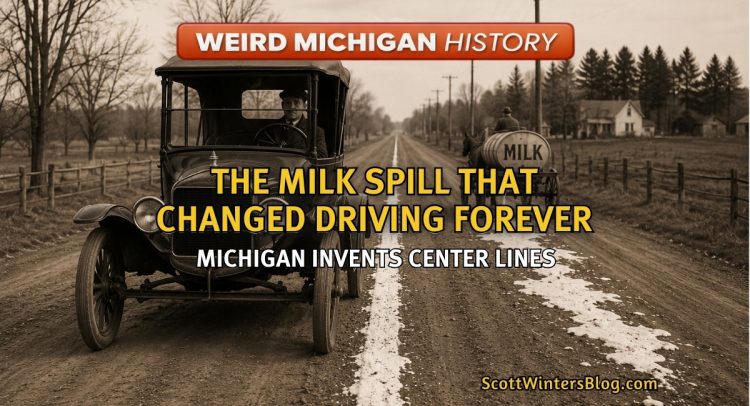
And according to one popular version of the story, it happened because of a spilled milk wagon.
In the early 1900s, automobiles were becoming more common, but roads weren’t keeping up.
There were no lane markings.
No center lines.
No clear rules for who belonged where.
Drivers simply shared the road and hoped for the best.
That became a problem as traffic increased.
Then in 1911, Edward N. Hines — chairman of the Wayne County Road Commission — reportedly noticed something unusual while traveling.
A wagon carrying milk had accidentally spilled, leaving a long white trail down the center of the road.
And suddenly…
Hines had an idea.
What if roads had permanent dividing lines?
The Weird Part
It sounds almost too simple.
One accidental spill may have inspired one of the most important traffic safety ideas in modern history.
Soon after, Michigan became the first place in the United States to begin using painted center lines on roads.
An idea born from spilled milk would eventually shape highways all over the world.
Michigan Tie-In
As the automobile industry exploded in places like Detroit, Michigan was constantly inventing new ways to adapt to a world suddenly filled with cars.
This may have been one of the simplest innovations…
But also one of the most important.
Final Thought
Most inventions come from laboratories.
This one may have come from a milk spill.
And more than a century later…
We still follow that line every single day.
.
